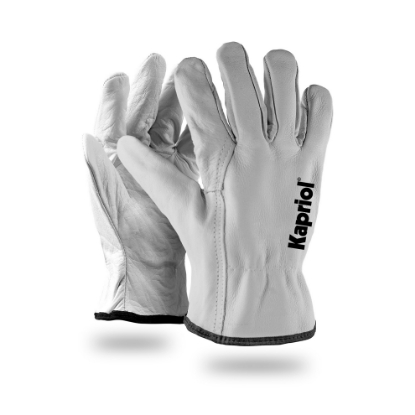


| Art./Item | Size |
|---|---|
| 28097 | 10 |
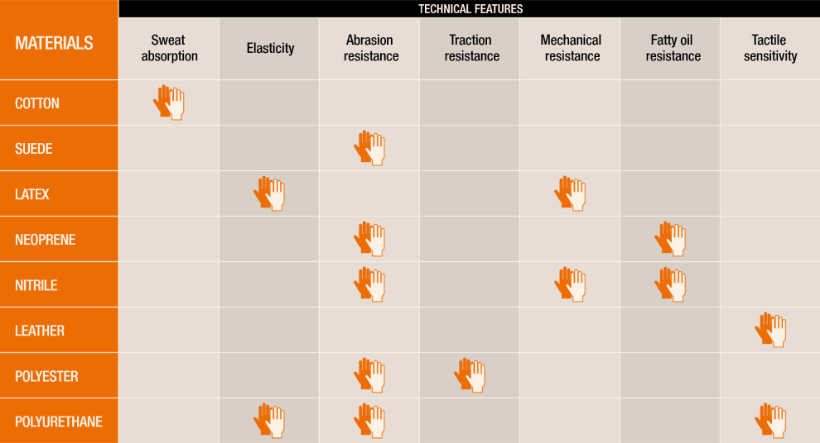
Blaster split leather gloves are designed to ensure maximum safety in high-temperature applications, offering an excellent combination of mechanical and thermal protection without compromising dexterity and precision. Made from high-quality suede leather, these high-temperature gloves provide excellent resistance to abrasion, tearing, and heat, making them ideal for intensive professional use.
Blaster gloves maintain good tactile sensitivity, essential for professions such as welding where precision and control are required.
The 15 cm cuff length effectively protects the wrist and forearm from sparks, radiant heat, and molten metal splashes, while the 1–1.2 mm leather thickness ensures durability and long service life even in demanding conditions.
Blaster welding gloves are certified according to EN 388:2016 + A1:2018, EN 407:2020, and EN 12477:2001 + A1:2005 Type A, ensuring high performance in thermal and mechanical safety for professional welding operations.
TECHNICAL SPECIFICATIONS
- Maximum mechanical and thermal protection
- Suede leather protects against abrasion, tearing, and heat
- 15 cm cuff protects from sparks and molten metal splashes
- 1–1.2 mm thickness for high resistance and durability
- Compliant with EN 388:2016 + A1:2018 / EN 407:2020 / EN 12477:2001 + A1:2005 Type A
MATERIAL
- Lining: split suede leather, thickness 1–1.2 mm
APPLICATIONS
- Professional welding
- Metalworking and carpentry
- Mechanical and shipbuilding industry
PROTECTION AGAINST MECHANICAL RISKS - EN 388:2016 + A1:2018
| Abrasion resistance | 4 |
| Cut resistance (Coup test) | 1 |
| Tear resistance | 4 |
| Puncture resistance | 4 |
| Cut resistance (TDM) | X |
HEAT AND FLAME PROTECTION - EN 407:2020 STANDARD
| Limited flame spread | 4 |
| Contact heat | 1 |
| Convective heat | 2 |
| Radiant heat | X |
| Small splashes of molten metal | 3 |
| Large splashes of molten metal | X |
Performance
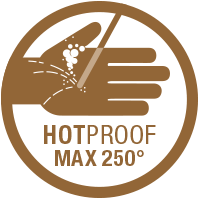


Heat Protection - Max 250°
Gloves providing thermal protection up to 250°C, ideal for handling hot materials without compromising safety.
Protection against mechanical risks
Gloves that protect against mechanical risks according to EN 388 +A1, evaluated through resistance tests for abrasion, blade cut, tear, puncture and cut according to the ISO method (TDM).
Protection against thermal risks
EN 388:2016 standard classifies protective gloves according to their resistance against mechanical risks. The resistance against ABRASION - CUT - TEAR - PERFORATION must appear in the pictogram relating to the standard. The revision of the previous standard (EN 388:2003) has made changes to the test procedures, especially for the CUT test, including an additional test.
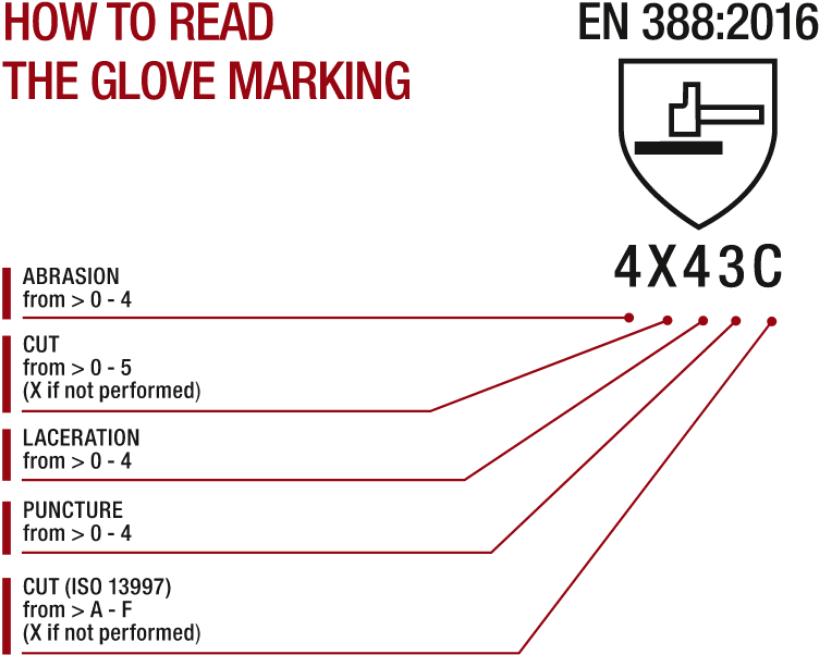
Test performed to provide an indication about the cut protection. The test is performed using a circular blade that moves on the surface of the gloves with a 5 newton pressure (Coup Test). The evaluation, from 1 to 5, is measured by calculating the number of cycles until the moment in which the blade penetrates the fabric.
For high cut resistance gloves (Coup Test 4 o 5) an additional test (EN ISO 13997) is carried out with a straight blade from which the force required to penetrate the fabric is detected. The value is expressed from A to F (F is the highest value).

The gauge represents the fineness of the knit used to create the glove’s fabric lining. It is a fundamental parameter in determining the dexterity, comfort, and protection level of the glove. The higher the gauge, the finer and more compact the knit.
The gauge directly impacts three key aspects: dexterity, comfort, and resistance.
HIGH GAUGES: 15G > 18G
- Characterized by a very thin and lightweight knit, offering high tactile sensitivity and superior ergonomics. Ideal for precision
work, assembly, electronics, and handling small components.
MEDIUM GAUGES: 10G > 13G
- Offer an optimal balance between protection, flexibility, and durability. Suitable for logistics, maintenance, light industry,
construction, and general-purpose applications.
LOW GAUGES: 7G > 9G
- Characterized by a thicker and more robust knit, designed for heavy-duty use requiring greater mechanical resistance, such as
construction, carpentry, and heavy material handling.
The choice of gauge enables identification of the highestperforming KAPRIOL glove for each activity, optimizing comfort, safety, and dexterity.
In this catalogue, it serves as an essential indicator to guide the customer toward the most appropriate technical solution.
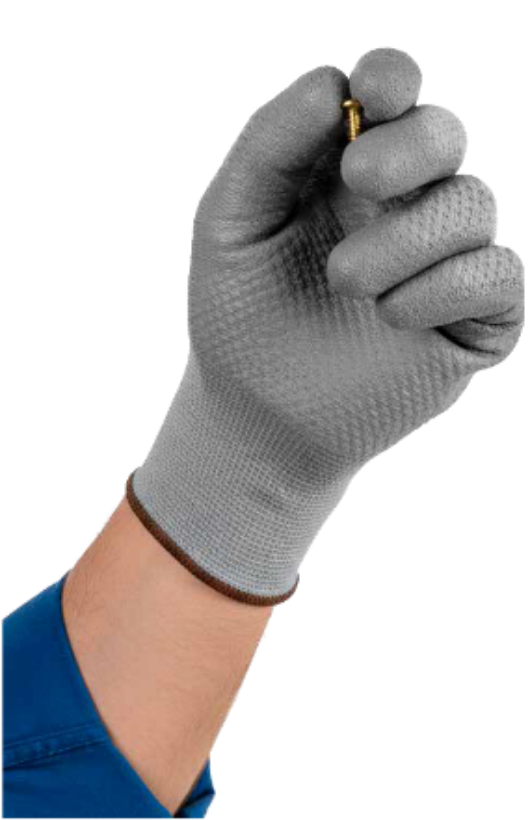
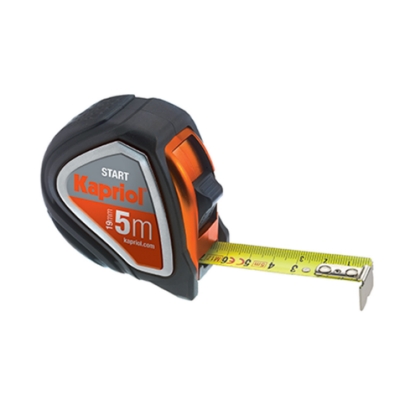
Tape measure with hook
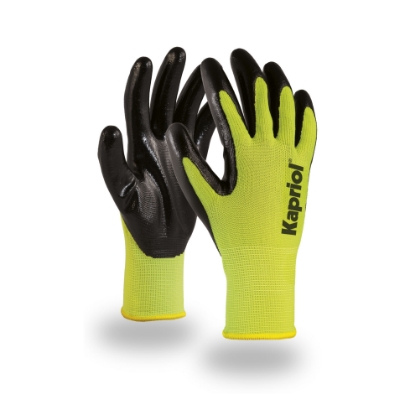
Ultra-flexible protective gloves
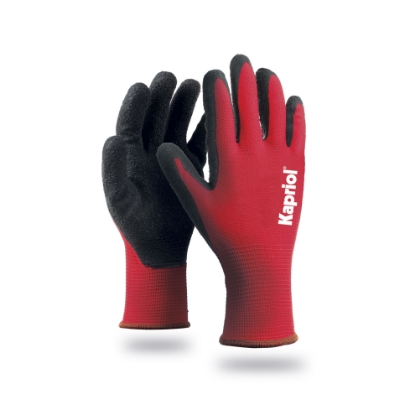
Ultra-flexible work gloves