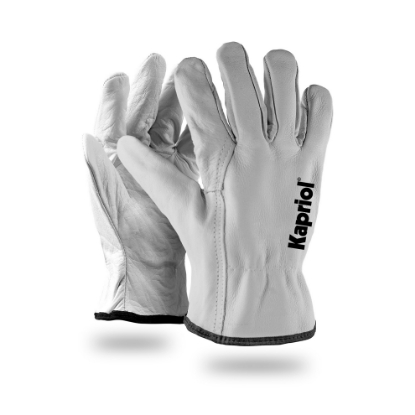


| Art./Item | Size | test |
|---|---|---|
| 80129 | 10 | EN388 - 3101X |
Chemical gloves are designed to ensure high safety in industrial and chemical environments, thanks to the full smooth nitrile coating with nitrile lining that provides an effective barrier against bacteria, fungi, and a wide range of chemical substances.
These work gloves offer basic mechanical resistance combined with excellent long-lasting chemical protection, while maintaining good ergonomics, flexibility, and a stable grip even in the presence of liquids.
Chemical protection gloves are certified according to EN 374-1:2016/A1:2018 (Type A) and EN 374-5:2016 for protection against specific chemicals, bacteria, and fungi. They are ideal for chemical industry work, professional cleaning, maintenance, water treatment, professional agriculture, and food industry applications where there is no direct contact with food.
TECHNICAL SPECIFICATIONS
- High chemical protection and barrier against bacteria and fungi
- Basic mechanical resistance
- Good ergonomics, flexibility, and excellent grip even with liquids
- Thickness: 1.6 mm
- Length: 30 cm
- Compliant with EN 388:2016 + A1:2018 / EN 374-1:2016/A1:2018 / EN 374-5:2016
MATERIAL
- Coating: double nitrile
- Finishing: smooth
- Lining: nitrile
- Finishing: flocked
APPLICATIONS
- Chemical industry
- Professional cleaning
- Food industry (non-direct food contact areas)
- Industrial maintenance
- Water and waste treatment
- Professional agriculture
PROTECTION AGAINST MECHANICAL RISKS - EN 388:2016 + A1:2018
| Abrasion resistance | 3 |
| Cut resistance (Coup test) | 1 |
| Tear resistance | 0 |
| Puncture resistance | 1 |
| Cut resistance (ISO 13997) | X |
CHEMICAL RISK PROTECTION - EN 374-1:2016/A1:2018 STANDARD
- J – n-Heptane
- K – Sodium hydroxide 40%
- L – Sodium phosphate 96%
- P – Hydrogen peroxide 30%
- O – Ammonia 25%
- T – Formaldehyde 37%
CHEMICAL AND MICROORGANISM PROTECTION - EN 374-5:2016 STANDARD
| Bacteria | ✔ |
| Fungi | ✔ |
Materials

Nitrile coating
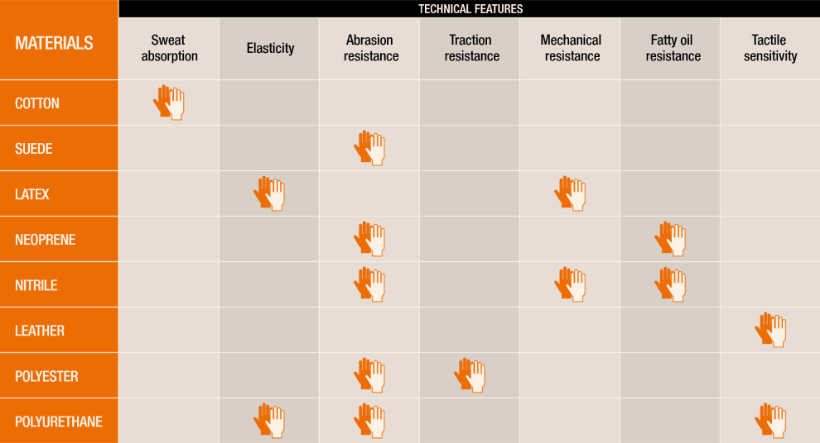
Nitrile is a synthetic rubber resistant to oils, solvents, abrasions, and punctures, maintaining elasticity and flexibility even at low temperatures. Hypoallergenic, it guarantees comfort, durability, and excellent grip on dry or oily objects, making it ideal for safe and effective work gloves.
Performance


Protection against mechanical risks
Gloves that protect against mechanical risks according to EN 388 +A1, evaluated through resistance tests for abrasion, blade cut, tear, puncture and cut according to the ISO method (TDM).
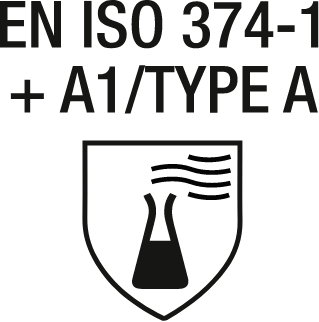
Chemical protection - Type A
Gloves that protect against chemicals and microorganisms according to EN ISO 374-1 + A1 Type A: protection for at least 30 minutes against 6 chemical substances: n-Heptane, Sodium hydroxide 40%, Sulphuric acid 96%, Ammonia 25%, Hydrogen peroxide 30%, Formaldehyde 37%.
Microbiological protection
Gloves that protect against microorganisms according to EN 374-5, evaluated for resistance to penetration by bacteria and fungi.
EN 388:2016 standard classifies protective gloves according to their resistance against mechanical risks. The resistance against ABRASION - CUT - TEAR - PERFORATION must appear in the pictogram relating to the standard. The revision of the previous standard (EN 388:2003) has made changes to the test procedures, especially for the CUT test, including an additional test.
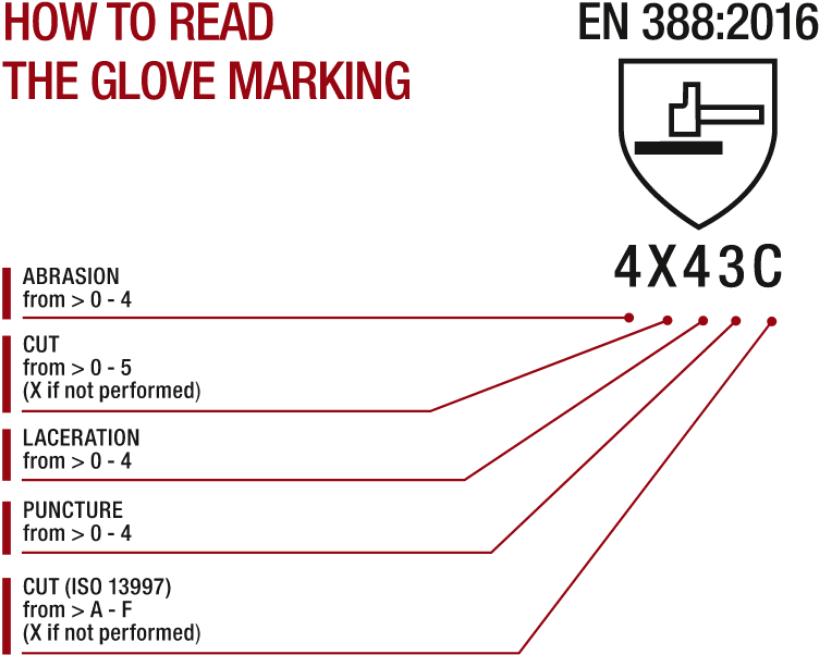
Test performed to provide an indication about the cut protection. The test is performed using a circular blade that moves on the surface of the gloves with a 5 newton pressure (Coup Test). The evaluation, from 1 to 5, is measured by calculating the number of cycles until the moment in which the blade penetrates the fabric.
For high cut resistance gloves (Coup Test 4 o 5) an additional test (EN ISO 13997) is carried out with a straight blade from which the force required to penetrate the fabric is detected. The value is expressed from A to F (F is the highest value).

The gauge represents the fineness of the knit used to create the glove’s fabric lining. It is a fundamental parameter in determining the dexterity, comfort, and protection level of the glove. The higher the gauge, the finer and more compact the knit.
The gauge directly impacts three key aspects: dexterity, comfort, and resistance.
HIGH GAUGES: 15G > 18G
- Characterized by a very thin and lightweight knit, offering high tactile sensitivity and superior ergonomics. Ideal for precision
work, assembly, electronics, and handling small components.
MEDIUM GAUGES: 10G > 13G
- Offer an optimal balance between protection, flexibility, and durability. Suitable for logistics, maintenance, light industry,
construction, and general-purpose applications.
LOW GAUGES: 7G > 9G
- Characterized by a thicker and more robust knit, designed for heavy-duty use requiring greater mechanical resistance, such as
construction, carpentry, and heavy material handling.
The choice of gauge enables identification of the highestperforming KAPRIOL glove for each activity, optimizing comfort, safety, and dexterity.
In this catalogue, it serves as an essential indicator to guide the customer toward the most appropriate technical solution.
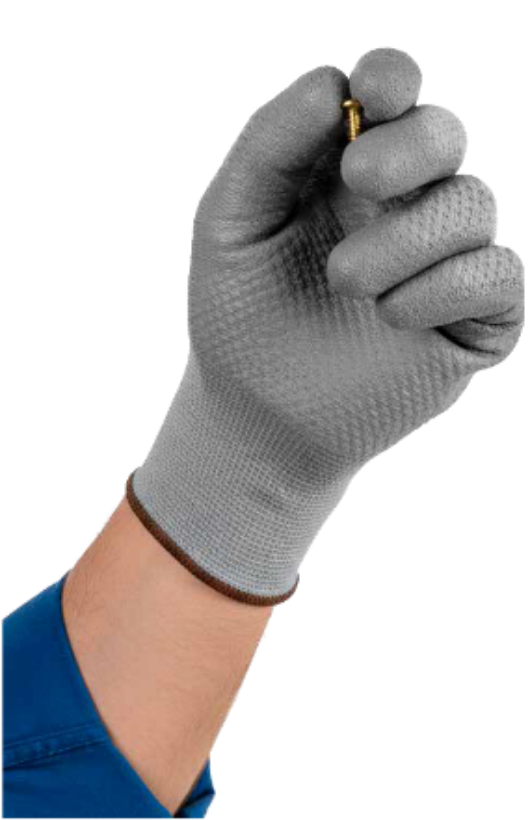
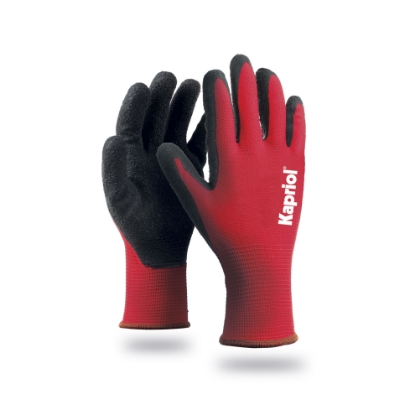
Ultra-flexible work gloves
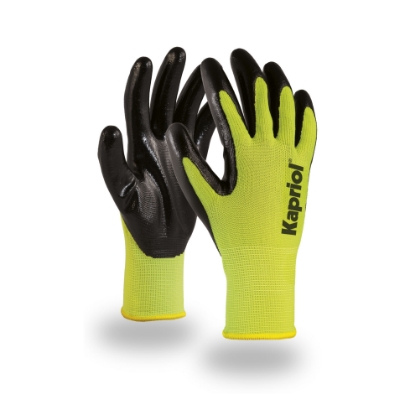
Ultra-flexible protective gloves
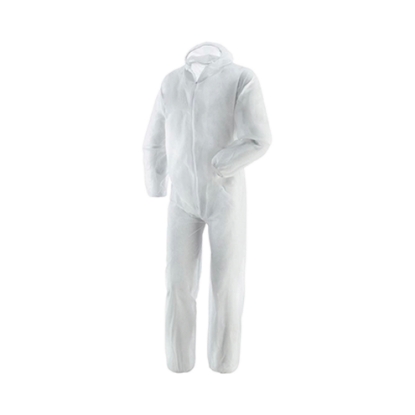
Disposable overalls