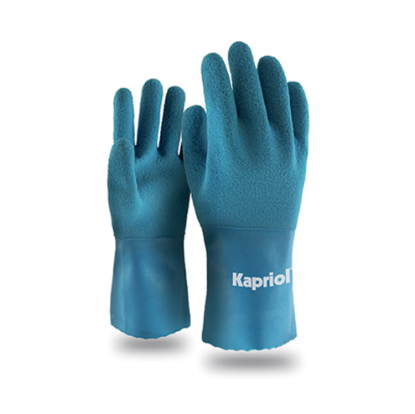


| Art./Item | Num./Size |
|---|---|
| 27705 | 9 |
| 27706 | 10 |
Top Rubber chemical protection gloves provide complete protection thanks to the full smooth latex coating, ensuring an excellent balance between mechanical and chemical resistance while maintaining lightness and breathability. The cotton lining ensures comfort and high tactile sensitivity, making these gloves ideal for construction, maintenance, and light industry applications.
Top Rubber latex-coated gloves comply with EN 388:2016 + A1:2018, EN 407:2020, and EN 374-5:2016 standards, providing protection against mechanical risks, heat and flame safety, and a certified barrier against microorganisms. These chemical protection gloves are suitable for environments requiring constant protection such as assembly work, industrial maintenance, biological waste handling, and chemical industry applications.
TECHNICAL SPECIFICATIONS
- High tactile sensitivity and secure grip
- Lightweight and breathable
- Excellent balance between mechanical and chemical protection
- Basic contact heat protection up to 250°C for short periods
- Thickness: 1.8–1.9 mm
- Length: 30 cm
- Gauge: 15
- Compliant with EN 388:2016 + A1:2018 / EN 407:2020 / EN 374-5:2016
MATERIAL
- Coating: single latex
- Finishing: smooth
- Lining: cotton
APPLICATIONS
- Assembly
- Industrial maintenance
- Biological waste handling
- Chemical industry
MECHANICAL RISK PROTECTION - EN 388:2016+A1:2018 STANDARD
| Abrasion resistance | 3 |
| Cut resistance (Coup test) | 1 |
| Tear resistance | 3 |
| Puncture resistance | 1 |
| Cut resistance (TDM) | X |
HEAT AND FLAME PROTECTION - EN 407:2020 STANDARD
| Limited flame spread | X |
| Contact heat | 1 |
| Convective heat | X |
| Radiant heat | X |
| Small molten metal splashes | X |
| Large molten metal splashes | X |
CHEMICAL AND MICROORGANISM PROTECTION - EN 374-5:2016 STANDARD
| Microorganisms | ✔ |
Materials

Cotton
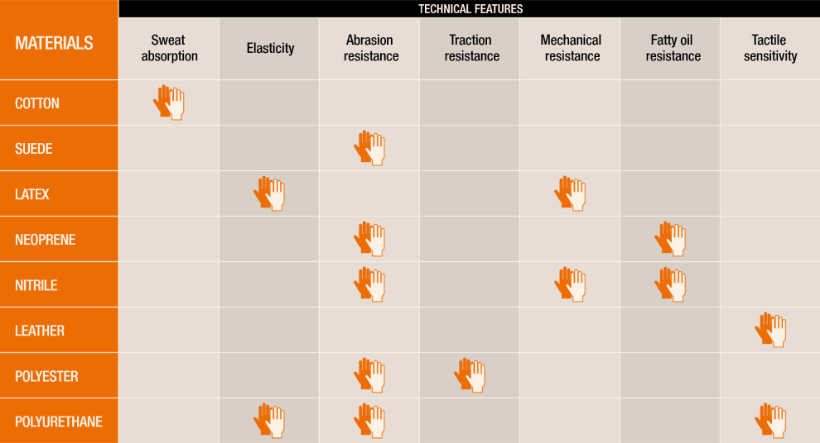
Cotton is a natural fiber characterized by softness, gentleness, and non-irritating properties. It helps protect against mechanical stress such as impacts, light vibrations, iron filings, splinters, and glass fragments. It promotes breathability, making the gloves comfortable even for extended periods. Cotton fibers are often integrated with polyester to combine comfort with increased mechanical resistance and high elasticity.
Latex coating
Latex is an elastic and resilient natural rubber, widely used in work gloves for its combination of flexibility, comfort, and protection. It ensures excellent grip and tactile sensitivity, allowing for precise movements even in detailed work. Latex offers good resistance to tears, light abrasions, and everyday wear. Furthermore, it is waterproof, protecting hands from water, dust, and light substances. Its natural elasticity makes it easy to don, adapting to the shape of the hand for an optimal fit.
Performance



Protection against mechanical risks
Gloves that protect against mechanical risks according to EN 388 +A1, evaluated through resistance tests for abrasion, blade cut, tear, puncture and cut according to the ISO method (TDM).
Protection against thermal risks
Microbiological protection
Gloves that protect against microorganisms according to EN 374-5, evaluated for resistance to penetration by bacteria and fungi.
EN 388:2016 standard classifies protective gloves according to their resistance against mechanical risks. The resistance against ABRASION - CUT - TEAR - PERFORATION must appear in the pictogram relating to the standard. The revision of the previous standard (EN 388:2003) has made changes to the test procedures, especially for the CUT test, including an additional test.
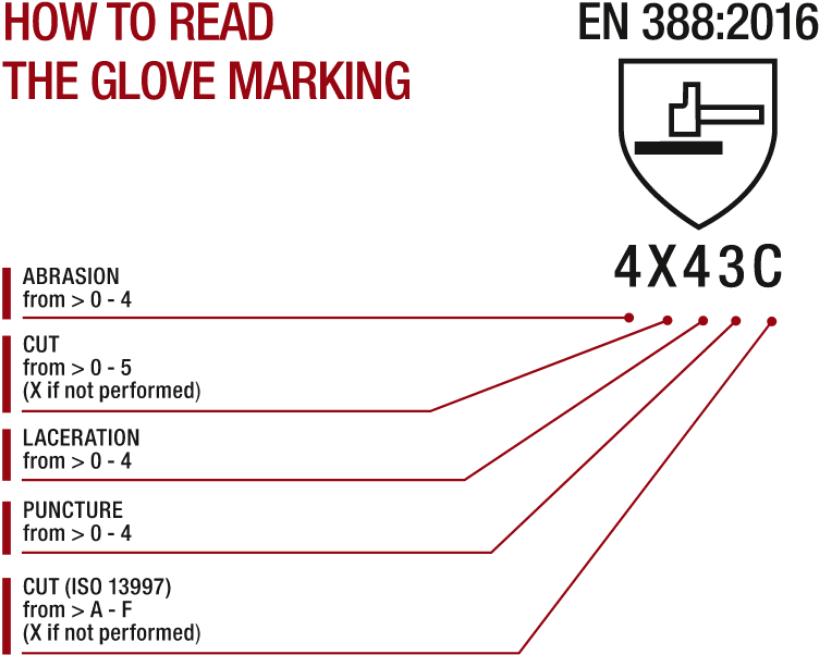
Test performed to provide an indication about the cut protection. The test is performed using a circular blade that moves on the surface of the gloves with a 5 newton pressure (Coup Test). The evaluation, from 1 to 5, is measured by calculating the number of cycles until the moment in which the blade penetrates the fabric.
For high cut resistance gloves (Coup Test 4 o 5) an additional test (EN ISO 13997) is carried out with a straight blade from which the force required to penetrate the fabric is detected. The value is expressed from A to F (F is the highest value).

The gauge represents the fineness of the knit used to create the glove’s fabric lining. It is a fundamental parameter in determining the dexterity, comfort, and protection level of the glove. The higher the gauge, the finer and more compact the knit.
The gauge directly impacts three key aspects: dexterity, comfort, and resistance.
HIGH GAUGES: 15G > 18G
- Characterized by a very thin and lightweight knit, offering high tactile sensitivity and superior ergonomics. Ideal for precision
work, assembly, electronics, and handling small components.
MEDIUM GAUGES: 10G > 13G
- Offer an optimal balance between protection, flexibility, and durability. Suitable for logistics, maintenance, light industry,
construction, and general-purpose applications.
LOW GAUGES: 7G > 9G
- Characterized by a thicker and more robust knit, designed for heavy-duty use requiring greater mechanical resistance, such as
construction, carpentry, and heavy material handling.
The choice of gauge enables identification of the highestperforming KAPRIOL glove for each activity, optimizing comfort, safety, and dexterity.
In this catalogue, it serves as an essential indicator to guide the customer toward the most appropriate technical solution.
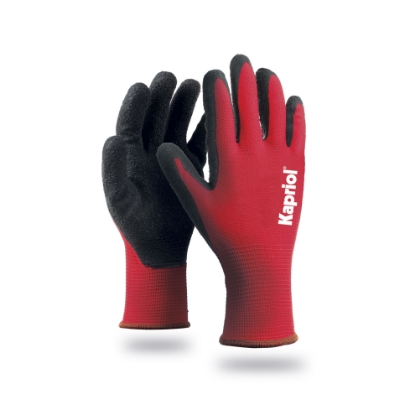
Ultra-flexible work gloves
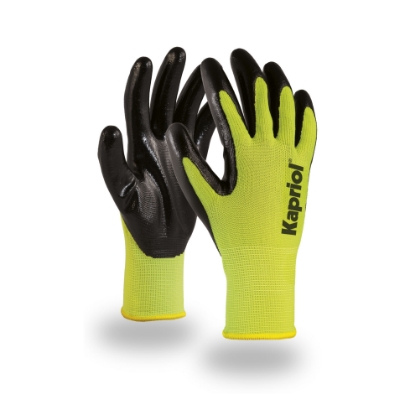
Ultra-flexible protective gloves
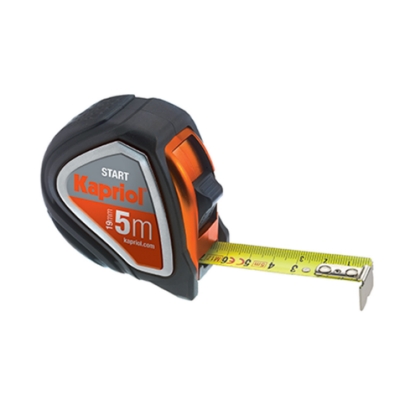
Tape measure with hook
Work gloves with nitrile coating
You may also be interested in:
Related products
Chemical protection gloves
Gloves for chemical hazard